
Build something the model can’t eat
Where value actually accrues in the AI application layer - and how it shapes the way we’re building ClubLe.

I am a founder, and I move fast, but I am after all an experienced Operator and a European. So. I went on holiday a few months into building a start up. 💁🏻♀️
Being on holiday doesn’t mean my brain stops working though. It means I have time to let it arrange the whirlwind of activity from the previous couple of months. And arrange it did!
I started thinking about not just whether what we are building with ClubLe is interesting (it is!) but whether we’d be building it 5 years from now.
The labs ship a new frontier model every few weeks. Capability that used to take a research team a year now arrives in an API update. And on top of that capability, a thousand applications get built - a wrapper for legal, a wrapper for sales, a wrapper for therapy, a wrapper for your wrapper.
The application layer is supposed to be where the value lands. Picks-and-shovels logic in reverse: the labs do the hard science, the rest of us capture the margin by putting it to work.
I think that’s only half right. If that.

Because the same capability that lets you build an app1 in a weekend lets the next person rebuild it in an afternoon - and lets the model itself absorb it in the next release. The hardest part of building anything right now is simple to say and brutal to live: you have to build more value than the tech can eat.
That’s the real question of this era. Not necessarily “what can AI do.2” But “what can you build that AI won’t quietly make worthless.”
The commodity is moving up the stack
For years, the scarce thing was intelligence. You paid for the model, the data scientists, the pipeline, the dashboard that turned numbers into a decision.
That’s inverting.
Intelligence3 is becoming abundant. Reasoning is cheap and getting cheaper. A clean UI is table stakes - an LLM can ingest your data and reshape it into whatever view you ask for, on demand. The interface, the summarisation, the generic “ask your data a question” layer - all commoditising fast.
What’s getting scarce is everything the model can’t generate for itself.
Unique data it has never seen. Judgement it wasn’t trained on. Trust it hasn’t earned. A real problem worth solving.
The model is crowded. The moat is scarce.
That shift is the whole game in the application layer.
Value accrues to whoever owns the loop
Every AI value chain repeats the same three steps: you take some data, you apply it to a problem, you implement a result. Model capability is collapsing the cost of the middle step to near zero. Anyone can apply intelligence now.
So value stops accruing to the cleverest application of intelligence. It accrues to whoever owns the two ends - the proprietary data going in, and the trusted relationship the result goes out to.
When the intelligence sits at the model layer, the app on top becomes a commodity. Swapping one model for another gets as easy as swapping socks. Which means the durable companies won’t be the ones with the best prompt. They’ll be the ones sitting on a loop the model can’t reach into: data it can’t see, and a relationship it can’t replicate.
Own the loop, and the model works for you. Rent the loop, and you work for the model.
Most of the application layer has a moat problem
Today, most AI applications are the same shape: a prompt, a model, a thin layer of UI, a go-to-market.
Pull the model out and there’s nothing underneath.
Founders feel it. The questions in every room right now are some version of: What’s actually defensible here? What stops a lab from shipping this as a feature4? What stops the next team from cloning it by Friday? Why would anyone stay once the novelty wears off?
None of those questions are answered by a better prompt. None of them are answered by a nicer interface.
The application layer doesn’t need more wrappers. It needs applications with something underneath them.
What actually defends an AI application
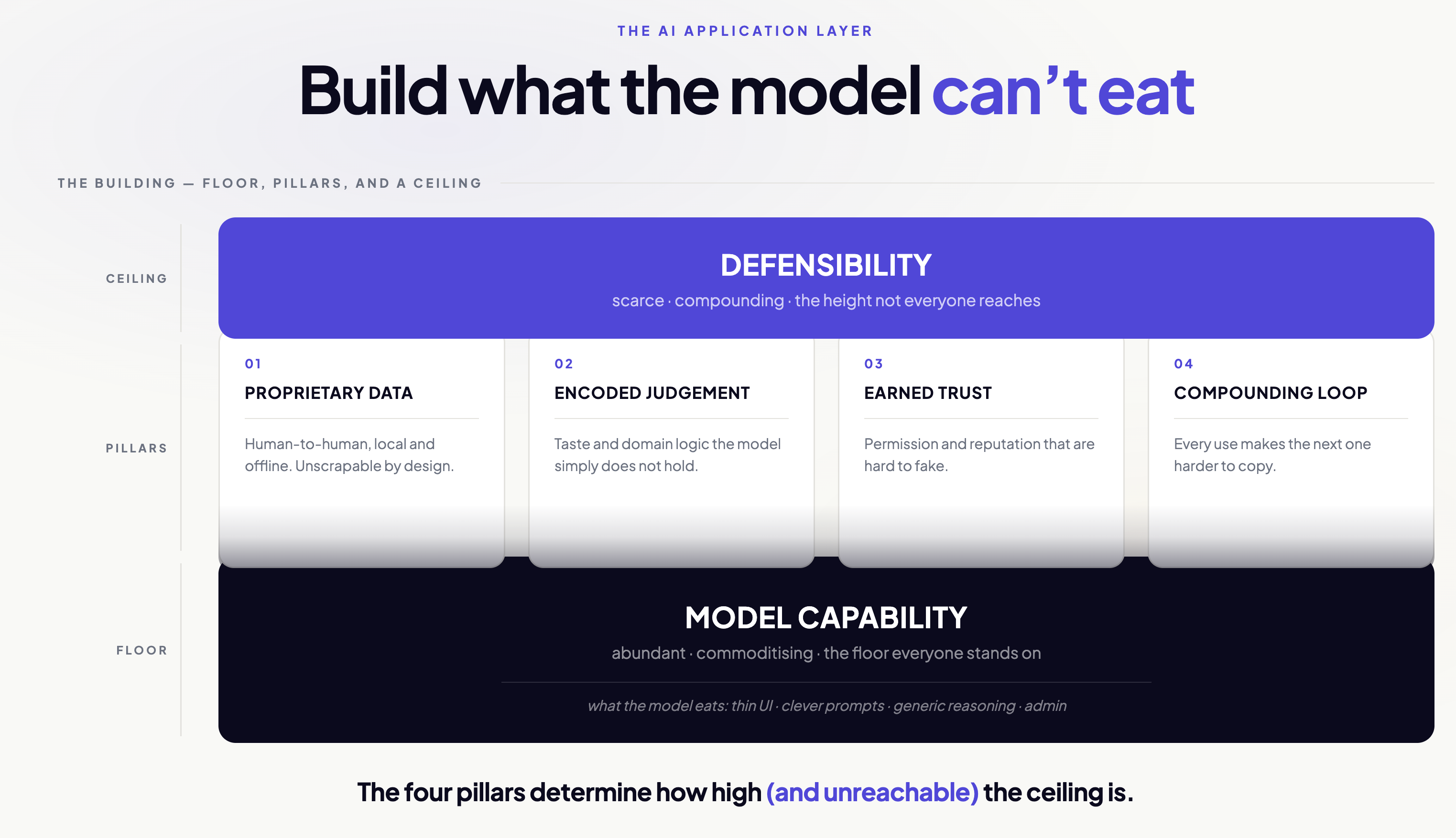
I think there are four things - and only four - that the model layer can’t eat. A defensible AI company is built on at least one, ideally a compounding stack of all four.
Proprietary Data. The one input a model cannot regenerate, because it has never seen it. Not data you bought - data you generate by owning a real workflow no one else sits inside. And the strongest version does two things a scraper never can: it captures a human-to-human relationship - who actually trusts whom, who shows up for whom - and it lives offline, in moments that were never posted, never logged, never digitised. A model can ingest the entire public internet. It cannot ingest what never touched it. That’s the data competitors can’t buy and the model can’t crawl.
Encoded Judgement. The opinionated layer. The taste, the domain logic, the hard-won decisions that turn a generic capability into the right answer for a specific person in a specific situation. The model gives you fluency. Judgement tells you when you are playing the man (or woman) and not solely the game.
Earned Trust. Permission and reputation. Whose name is on it, who vouches for you, why someone lets you into a moment that matters. Trust is the slowest thing to build and the hardest to fake - which is exactly why it’s worth building.
Compounding Loop. Every use makes the product better in a way a competitor can’t shortcut. Data feeds judgement, judgement earns trust, trust generates more data. If your product doesn’t get more defensible the more it’s used, you don’t have a moat. You have a head start.
Capability is the floor. These four are the building. Anyone can stand on the floor.
Deploy local. Scale through architecture.
The four moats tell you what to build. This is about how you ship it - and at first it looks like a contradiction.
The deepest moats above - offline data, human relationships, trust — are inherently local. They form in a specific room, a specific community, a specific set of people who know each other. That’s what makes them unscrapable. It’s also what makes them look impossible to scale.
I think that’s backwards.
The thing that looks un-scalable is exactly what makes it defensible. The move isn’t to abandon the local5 - it’s to build infrastructure that lets you replicate the local. Deploy into one community at a time, where trust actually lives, and make the manner of deployment and distribution so repeatable that the hundredth community is the same motion as the first. It’s where many niche products die. There is a real opportunity to change that.
Local is where the value forms. Hyper-scalable in how it spreads. You don’t trade defensibility for scale. You engineer both.
This is what we’re building at ClubLe
ClubLe is an AI-native company. But AI is the engine, not the product.
We put just enough AI into solving a genuinely human problem: people are lonelier than they have ever been, and the tools meant to connect them mostly keep them on a screen. We’re not building another feed. We’re building an infrastructure layer for the real world, that helps people form real connections, in the real world, around things they actually show up for - and keep showing up for, every time.
The tech underneath is horizontal: most of what we build applies to almost6 anyone, anywhere. So the discipline isn’t in the model. It’s in the go-to-market, which is deliberately vertical - we start narrow, inside a single activity and the real clubs and regulars that already exist around it. You don’t solve loneliness by starting with the people who won’t leave the house. You start with the people who already get out to play, and you make that better. Then you pull the people who needed a nudge.
Here’s why it lines up with everything above: the moat isn’t the model. It’s the loop. The proprietary data we generate about how real communities actually connect - human-to-human, offline, in moments no one ever scraped. The judgement we encode about what makes a session work. The trust we earn by protecting the experience instead of strip-mining it. None of that ships in a frontier model’s next release - and all of it compounds.
And we deploy it the way I’d argue you should: hyper-local, one community at a time, where trust is real - on infrastructure built so the hundredth community is the same motion as the first. The value forms locally. The distribution scales anyway.
We’re building an AI-native company the way I’ve argued companies should be built for years: company over functions, analytics over ego, outcomes over optics. The conviction in this digital infrastructure for the real world came after the analysis, not before it.
Final Word
For the last two years, the easiest companies to start were thin layers on someone else’s intelligence. Spin up a wrapper, ride the capability, hope the model doesn’t eat you before you raise. If you are Harvey, be smart enough to generate your own data.
I think there is a new place where a lot of new companies will come from:
from a real-world hyper-local-but-pervasive problem, where the human x human connection generates unique real-time insight, where judgement wins, and trust compounds until they’re impossible to copy.
Capability is everywhere now. That’s exactly why it’s worth nothing on its own.
Build something the model can’t eat.
That’s the whole job.
If you want to follow what we’re building at ClubLe, visit us on ClubLe.app
I am using that comparison but yes, we have all tried Lovable, and we know you can’t really have a functioning app that is remotely complex without some sort of expert knowledge and the dreaded maintenance. Or what are emerging to be the real bottlenecks in the system and why engineering jobs are not going away any time soon..
It can do a lot. But no it can’t do everything and it is NOT cheap. But we will leave that to another time.
Or at least “performative intelligence.”
Hi, Figma!
We would have never left the By Area with Uber if that were the case.
The “almost” is what needs scalability. More on this another time.