
Embedding AI solutions into your operations
Learnings from 10+ deployments in 12 months + bonus assessment tool!

Ever since ChatGPT burst on the mainstream scene, people in my circles are testing and implementing, failing and sometimes being successful, with their AI use. As a probabilistic technology, there is always the danger of a AI-powered workflow failing while sounding confident that - oh it didn’t. But yes, yes it did fail.
I have now AI-powered a number of workflows - for insurance companies, gifting companies, ‘traditional SaaS’ ones and more. Once you do this a few times you see the patterns. Today I am sharing my learnings about how to set your AI-powered workflows for success.
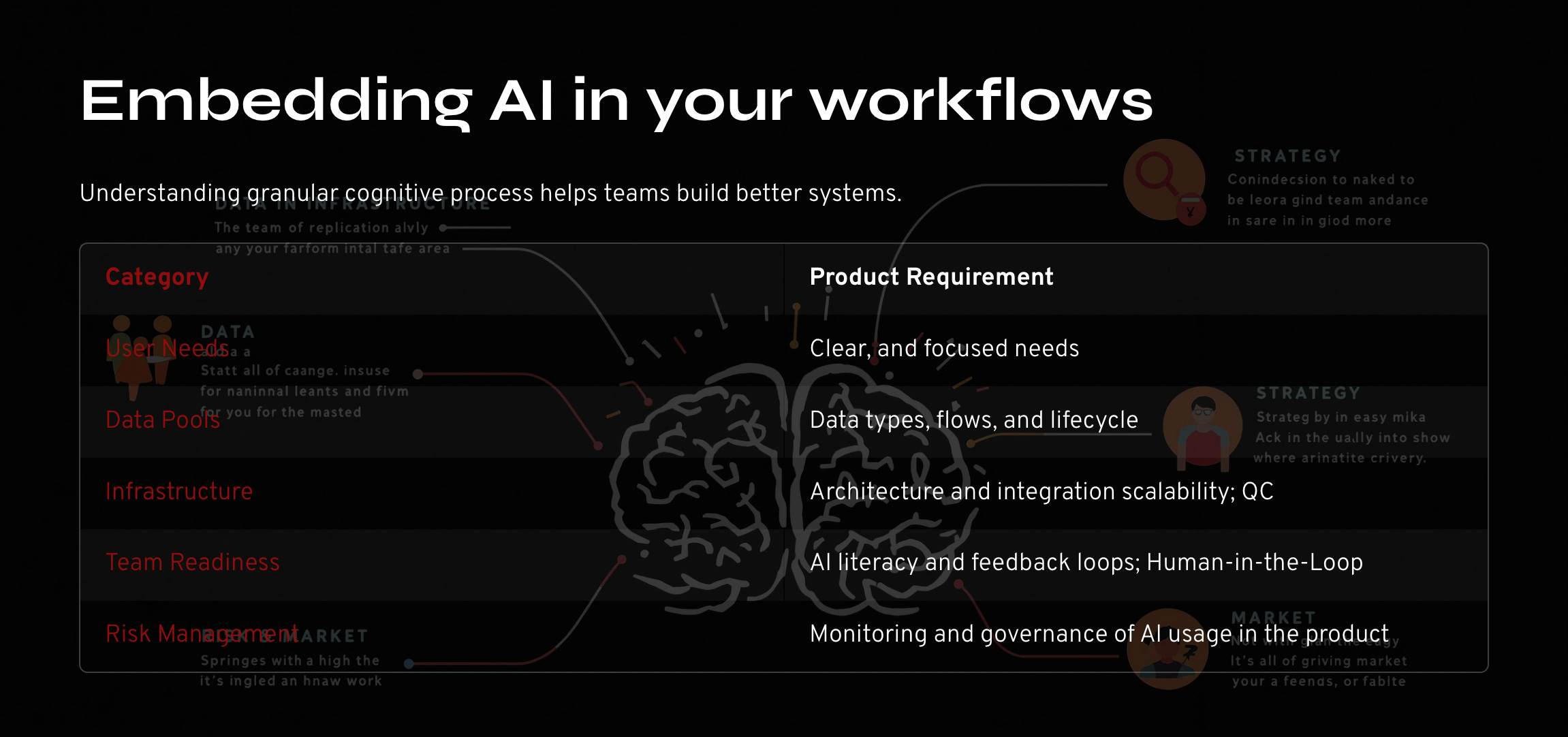
I think of each AI deployment as a product in itself. It has users, it has a purpose, it has a data structure. And each category has some requirements to 1) be successful, and 2) at least reduce failure rate.
User Needs
Just like you would with an MVP, start with the user. Who is the user, and what is the general workflow they have. From there, what specifically are their pain points? Is it extracting raw data? Structuring it? Uploading it into a fancy BI tool? Map out the steps and friction points.
For example, an insurance company provides a service to settle responsibility for insurance claims. The process involves a member of the CS team visiting a cient’s site (driving or via public transport), conducting a survey (by inspecting and documenting), recording the survey (by hand), later evaluating insurance policies, and writing up a report.
If you want to embed AI in this, you have to be ultra specific:
Don’t think of a general “writing this report takes me 3h and I am irritated by it”, but “writing this report requires finding an old case, referencing the number, finding the detail about the insurance associated with the client, matching their insurance policy to the claim.. etc etc.” Break down the cognitive tasks into as small pieces as possible.
outline the specific steps a user takes in working through a project
the more granular, the better
define a tight scope for a potential task to automate with AI