
Why you need a strategy
It's not why you think...

In the last week I had two moments that brought to the forefront of my attention a simple question: why do you need a strategy in the first place?
In both my own company, and a company I dearly love and advise, occurred the a-ha moment of “this is why you write things on a piece of (virtual) paper, and you keep that on your desk(top) if you need to.”
We have spoken about strategy a lot here. My work at Uber, WeWork and Hopin brought to life the in the Strategy Planning series ties all together how to create a strategy and execute on it. Like how you get your leadership team to make even remotely cohesive decisions; how to design a thoughtful strategy; and how to guide your team through that whole process. As a bonus we also spoke about putting it all on one single sheet of paper. It is all about How you do it.

But the meta question of Why is missing.
The signs you need to get back to the Why
And this week I got a light bulb moment, not once but twice!
Imagine a scenario in which a team has multiple meetings on the topic of “weekly to-dos". They spend 3h on it. And at the end of the three hours, people go away, they do some work, feel busy, and next week they repeat the process. People are busy. But nothing gets done. And by “nothing” I mean, nothing that moves the needle for the business.
I sat down with the team some months ago and pressed them hard to put pen to paper and draw out their strategy and priorities. They did. They already knew a lot of what they want to do, and were conceptually aligned. But then something else happened. In the time between seeing me they’d gone off, and continued working as usual from their excel sheets with lots of ticks and “done”-s, etc. But connecting the day-to-day to the strategy? No.
This was a good reminder: why do you have a strategy? To get you to prioritise the stuff that moves the needle. Not next week. Now. And not spend time implementing Canva if that’s not an immediate value add.
In the second example, we had a different issue. At ClubLe we are ruthless with our time. We are ruthless with our focus. And we are ruthless with what we build. The tech is - as I like to call it - horizontal. You can apply 90% of it to most people, to most cases (it’s something we’ve been aware of and careful about form day 0 - because that’s where a lot of well-meaning products go to die). But the GTM is vertical - it relies on a specificity of an activity or hobby. The point is to get us going, to get a critical mass of people who prove the business case and most importantly - the value an ambitious product delivers. We are starting with Padel but shortly moving to other activities too! But of course we know a lot about padel now and what value our product can deliver for users and clubs.
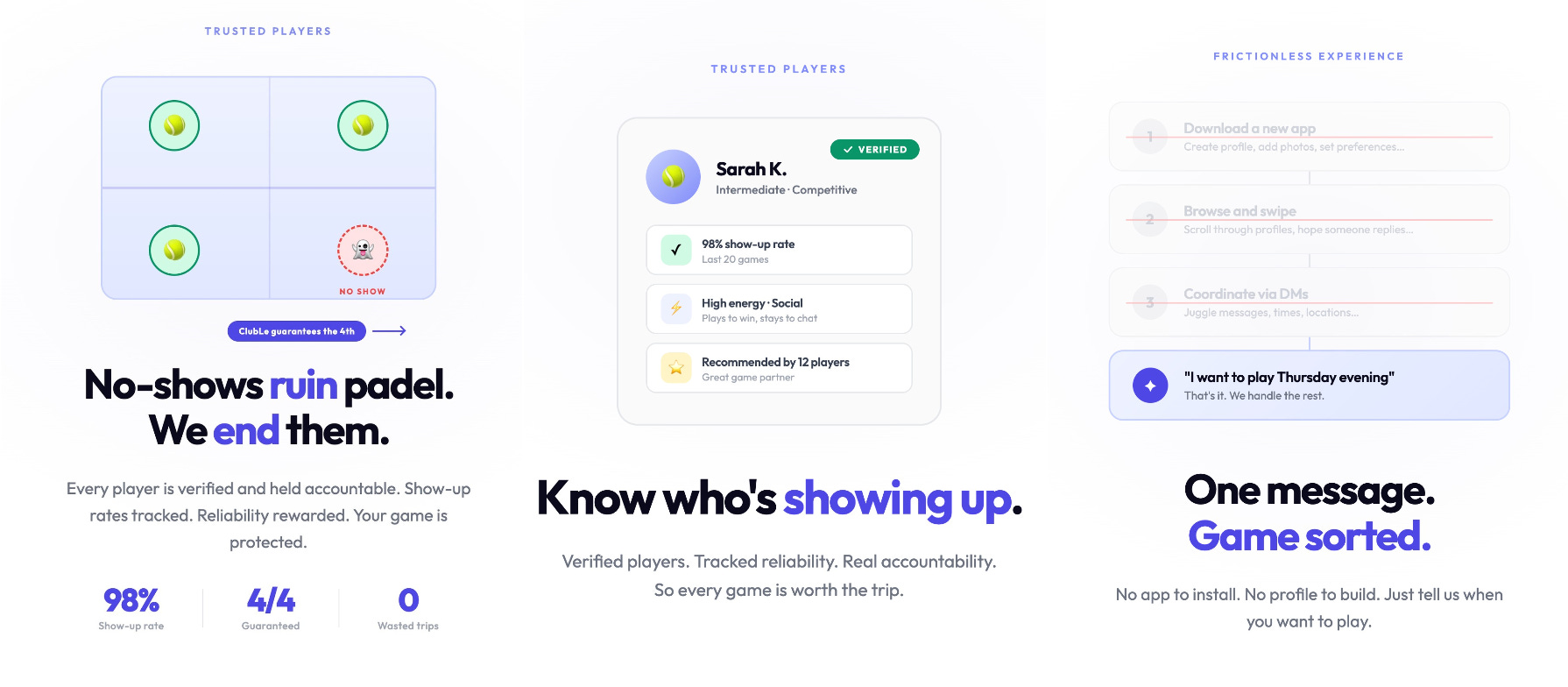
We are solving the loneliness epidemic, getting people to find the kind of people they can form real deep connections with - over time. We are not solving a transactional problem. We are doing this to have much much bigger impact (this is why we are basing it on real, actual, actionable science!). Even the campaign we ran has a very human visual:

But a request from a partner left me shouting in my head “No No No.” We are still at a point when we are willing to co-design a solution with our users. But we can’t compromise the original thesis about why we started. And why we started is to solve the loneliness epidemic, and get people to form real human connections. Over time. Through thick and thin. That’s it. That’s the strategy. (it is not doing a billing tool, so we won’t go there in the slightest. does padel need better solutions for scheduling? probably. but that’s not us).
This was another good reminder: why do you have a strategy? To keep you focused on building what matters, and not solving problems which are better solved by someone else.
Final Word
So take it from me. Someone who has worked in strategy for 17 years: Write your strategy down. For your own sake. It is not just for ‘clarity’ or to ‘align’ teams or assign ‘budget.’ It is really to:
Stop re-litigating first principles every week. Without a written strategy, every debate bares the risk of restarting from zero and the loudest voice winning. With one, you're not arguing opinions - you're checking work against a thesis you already agreed on.
Pre-decide what you'll say No to. The hardest moments aren't choosing what to build; they're refusing the partner, feature, or shiny request that quietly pulls you off thesis. I am yet to become truly allergic to the stuff that is off-brief. As we grow ClubLe this will become much easier.
Force the link between calendars and the needle. Strategy is what turns "we're busy" into "we're moving" - without it, your weekly to-dos are just a tidier way of running in circles. I am yet to create a good visualisation of the strategy-to-daily to dos system, but more on this soon.
Next time someone says “just move fast and break things, why do you need a strategy”… wellllll, you have something to tell them.
Love and Stealing with pride, "Stop re-litigating first principles every week"
I think in a healthy dynamic organization there should be some tension between 'breaking things fast' and accoutability that you're focused on the right things to achieve your strategy.
Alexis