
You are not creating a "NEW CATEGORY"
Unless you are. Here is how to know if what you are building is that radically new

I have been thinking recently about ‘categories.’ There have been a lot written about creating categories - Play Bigger, Category Creation, Category design toolkit - and founders I speak to are obsessed with creating a NEW CATEGORY! Say it louder! I will cover my ears in the meantime.
If you read through any material about new category creation, you will see a lot of focus on cultural context, defining the category (give it a new catchy name!), and engaging early adopters. I have worked with founders in the past who obsess over the name. “What should we call it? How do we make it catchy? Does it need to be more catchy or more accurate?” (“vibe coding” anyone?)
None of this matters. Because most of the time when founders talk about a new category, they mostly mean a unique positioning for the company. And that’s ok. But that doesn’t mean they are building a new category. 🦚
A fully fledged new category is a completely different animal. It goes beyond a positioning. It is a specific type of positioning, defining a whole new generation of companies. Here is how I define it (bullet points to stress the three components):
A new category is a way for a…
consumer need
…to be fulfilled in a way that delivers…
radically more value at radically more scale at a radically lower cost
…, most often than not, through…
the means of a new technology.
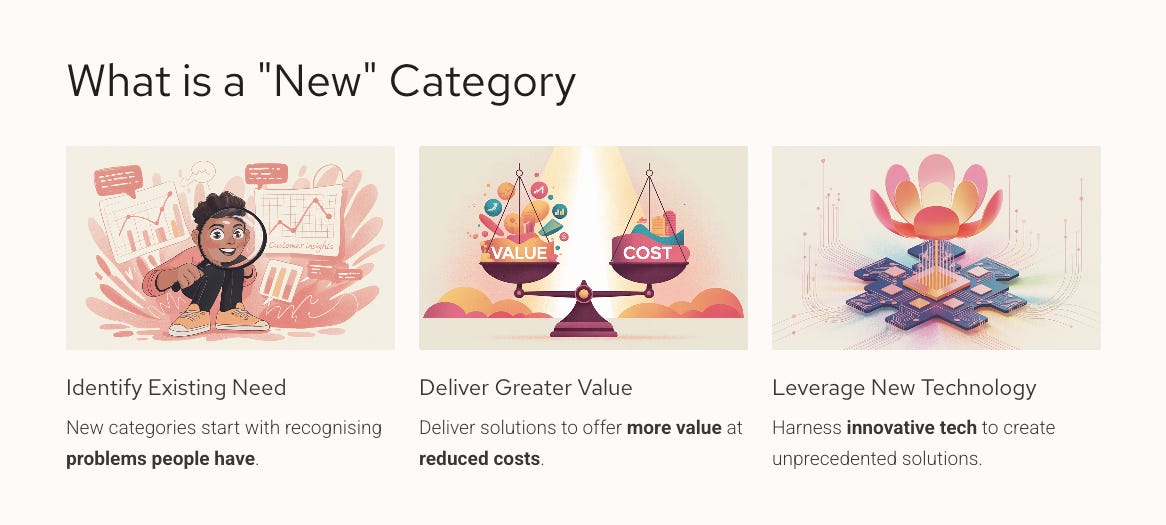
The key thing here is that some technology - and your customers often don’t give a flying eff about what kind of technology as long as it is reliable, safe, and compliant - enables you to deliver a radically new experience. The new experience is in the form of:
much much more value (defined based on what you offer and for whom),
but at a lower cost (so that you keep prices fair - customers’ WTP doesn’t just go magically and infinitely up),
and subsequently at a larger scale.
Now, if you think of companies that have actually created new categories, here are a few examples:
Salesforce
Category created: Cloud-based software / Software-as-a-Service (SaaS)
Need: Customer relationship management (CRM)
New technological leverage: Cloud computing
Value creation:
More value: Previously, CRM systems were on-premise and took months (or years) to implement. Salesforce offered instant access, updates, and collaboration over the web.
Lower cost: Customers didn’t need to pay upfront license fees, buy servers, or manage installations. The subscription (pay-as-you-go) model made it far more affordable, especially for SMBs.
Greater scale: The cloud model allowed global access and massive scaling without the friction of traditional enterprise software deployments.
Marketplace economics:
Salesforce broke the traditional enterprise software model by turning software into a service. Instead of big one-time deals with perpetual licenses and expensive maintenance contracts, they created predictable, recurring revenue with high gross margins and low marginal cost for additional users. It expanded the TAM by democratising CRM - suddenly even tiny teams could afford world-class software.
AirBnb / Uber
Category created:
Airbnb: Peer-to-peer short-term rentals
Uber: On-demand ride-hailing
Need:
Airbnb: People need somewhere to stay when traveling
Uber: Urban mobility
New technological leverage:
Smartphone GPS + fast mobile internet + digital payments
Value creation:
More value:
Airbnb: More choice, more authentic travel experiences, often in locations where hotels were limited.
Uber: More availability than legacy taxis, faster pickup times, and seamless digital payments.
Lower cost:
No need for Airbnb to own property or Uber to own vehicles. Lower operating costs passed through as cheaper prices for consumers.
Greater scale:
Rapid global expansion with minimal physical infrastructure. Every city had underutilised cars and homes.
Marketplace economics:
These companies introduced supply-side monetization of idle assets. By turning individuals into service providers (drivers, hosts), they redefined labor and asset utilisation models. Their marketplaces used network effects to drive down cost-per-transaction while maintaining high liquidity (matching supply and demand quickly). High take rates on each transaction meant strong unit economics once scale was reached.
Netflix
Category created: On-demand video streaming
Need: Convenient access to entertainment content
New technological leverage: High-speed internet + high quality streaming + smart devices
Value creation:
More value: Watch anywhere, anytime, without ads or scheduled programming. Massive long-tail content availability plus eventually original programming.
Lower cost: One subscription replaced costly cable bundles or per-rental models.
Greater scale: Digital distribution meant they could reach a global audience without physical infrastructure (vs. DVDs or brick-and-mortar rental stores).
Marketplace economics:
Netflix evolved from DVD rentals to a streaming platform, aggregating content and later producing originals. Streaming radically reduced distribution costs, enabled zero marginal cost per view, and allowed personalised experiences at scale through data and algorithms. Their fixed-cost subscription model (with high customer lifetime value) created a cash engine to fund original content, thus vertically integrating the value chain and locking in customers.
Final word
As you see form the examples, a new or matured tech gives rise to new opportunities for delivering value through new business models. Whether that’s Saas, digital marketplaces, or on-demand content, these companies show that a new category is much more than a positioning. Without the new tech and new business model, there is no new category. No matter how much you want to scream it into existence.
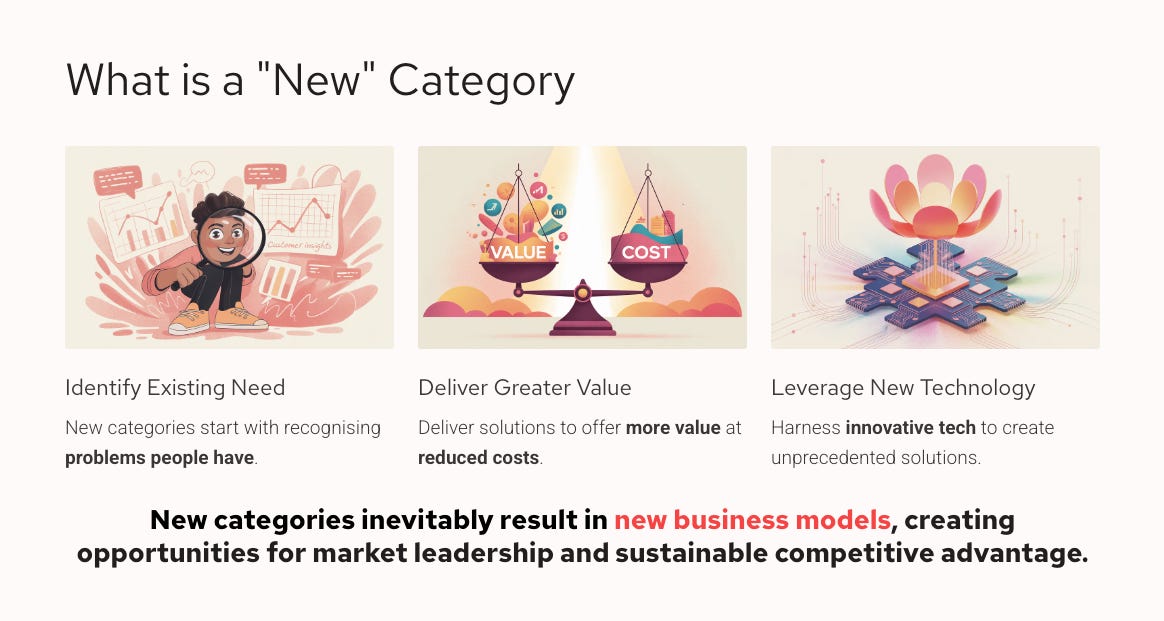
Once you have these, you can go and package your offering in a way to dramatise the exceptional value you are offering. And give it a cool name. But just not “vibe coding.” Everyone hates “vibe coding.”