
Mini CEOs
From Problem Solvers to Future Forecasters

Since the dawn of the industrialised society, companies have organised around a common goal, with people serving three key roles: vision, management, and (often very, very hard) work. From textile factories, automotive assembly lines, ship-making companies, to computer conglomerates, it is a common structure. It took typically a visionary leader, with a handful of managers, and an overwhelming number of workers to achieve extraordinary things. Like for example, to build the Titanic in only 26 months. The Titanic was built, history will say, by the Harland & Wolff company, with William James Pirrie at the helm as chairman, and Thomas Andrews as GM and Alexander Carlisle as Head Designer. But also, by 3000 other men, who worked in an extremely dangerous environment, underpinned by deafening noise. Three levels. A visionary, a management team, and a lot of people to do the work.

The type of work we do
The type of work that happens at each level is fundamentally different. From bottom to top, the context goes from narrow to broad, the work often from more “manual” to more “intellectual”, the people from less experienced to more experienced, and the time scale of value add from shorter to longer.

Overall, the level of complexity at each level gets progressively higher.1 There are more business lines to consider, more markets, more teams, more demands, more types of customers, longer context widows to worry about, etc. Communication becomes the currency of operations.
Work yesterday = Problem Solving
Today, many product companies follow a similar structure, but without the deafening noise of steel, hammers, and shouting (unless your management team talks too much about Elon 🤣). Work is again split in three levels, with a visionary founder at the top, a handful of execs around him, and a horde of ICs and small managers driving the work. There are people who write code, people who oversee teams writing code for a specific part of the app, and people who care about the KPIs for delivering said code, but also look at the foresight of what to build next. Leaders undertake weeks or months long project to define the root cause of problems, involving their own and cross functional teams, countless excel models, and presentations. Only then can they embark on the arduous adventure of solving.
We know how to Problem Solve, but it has not been scalable.
We already know that this type of work will change. How? After spending countless hours talking to fellow Operators, and reading Gianni’s, Luca’s, Azeem’s thinking about AI, I am optimistic about how our roles will evolve.2
Work today = Problem Solving ^ 2
Now, if you have been using a variety of AI applications in your work, even if still nascent, you will have sensed a shift in perspective. You can already see benefits of being better, and faster for a variety of use cases. For any business problem, you now have the time to think holistically about:
the whole System, rather than each slice at a time
the Objective / KPIs / Success criteria to set
how to validate your Strategic direction
what insight you should use
how to enable and coach others
If you are a senior leader, you already think this way. New tools are already making you better, faster, and more independent at Problem Solving.
But in the advisory work I do, I see some magic happening: I see junior people starting to naturally think this way too. I see various team leads, sitting in eng, or in GTM, starting to think this way.
No prompt needed. They are not only thinking about “that thing in Billing” but “that thing in Billing that will have to work with those other things in Procurement and Sales.” Not only thinking about “will it work tomorrow” but “will this work 6 months from now when we 5x growth.”
We are already getting better, faster, and more independent at Problem Solving.

Work tomorrow = Problem Forecasting
This brings me to a speculation. I think we are at the beginning of an inflection point in the level of complexity of work that people will handle.
If we follow the logical extrapolation of how we have solved Problems up until now, and how quickly it is becoming more scalable, our work will evolve turning each person in a company into a “mini CEO.”
Each mini CEO (mCEO) takes care of a set of decisions, that influence a specific part of the market the company operates in. Each one influences a motion: setting success criteria, validating strategy, and enabling a plethora of AI and human agents to deliver.
This is a fundamental shift in the role humans play in organisations, moving them to a higher plane of complexity. In such a world mini CEOs shift their attention:
from the next 3 months, to the next 3 years
from one team, to the whole ecosystem
from patching issues to identifying valuable business opportunities
from (historical) insight, to (forward) foresight
from reporting, to scenario planning
from planning the 1st degree effects, to forecasting and testing for the 2nd and 3rd
From drudgery, to imagination.
mCEOs will have to hone their skills in evaluation of potential business directions, prioritisation of which Problem to solve and when, weighing success criteria for the short- and long-term, and overall, guiding the strategic direction in unison with other mini CEOs. mCEOs will orchestrate motions such as a GTM motion, a BU, a regional market, or any unit that makes sense in the organisational structure of the company. I can see a mesh of functionally vertical and horizontal mCEOs, operating a mesh of AI agents and other mCEOs. In this world, forecasting distinguishes the winners.
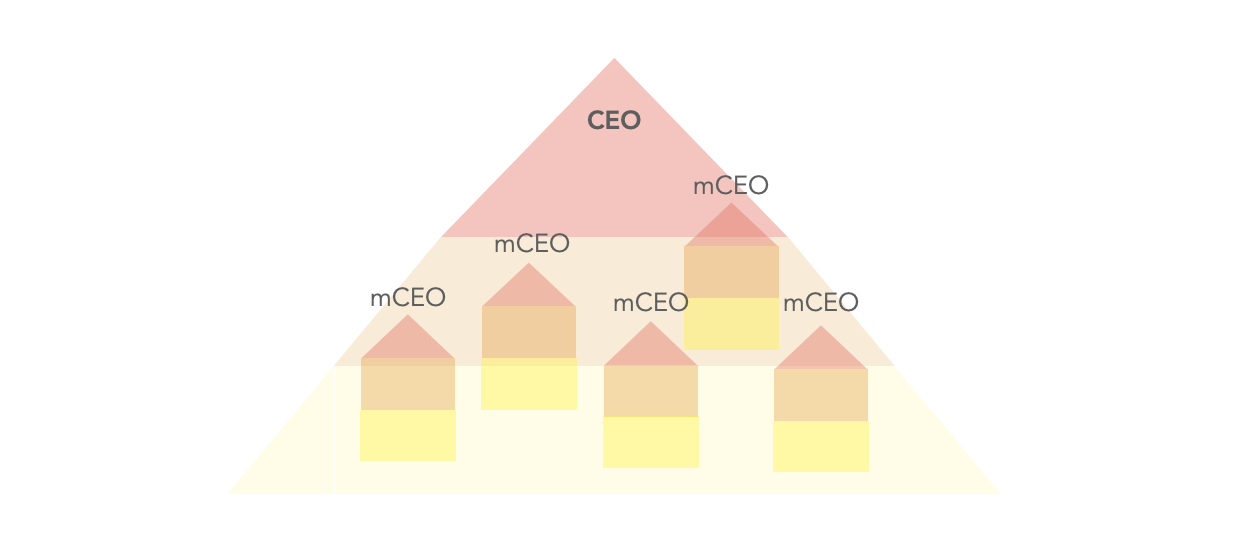
We will be Problem Forecasting. That is, finding the “right” problems to solve, and anticipating the next frontiers. And then doing it yet again.
The role of the CEO at the top is still to set the agenda for the direction of the business based on vision, and forecast. But the CEO will have another role, to anticipate, evaluate, and resolve current clash points between the motions mCEOs drive. Such resolutions will sit in the edge case zones of operations, and would depend much more on the vision and long term direction, rather the day to day operational debt of the company.
AI is not a machine meant to replace humans. It is meant to take the machine out of the human. And unleash people’s creativity, experimentation and imagination.
I am personally really excited about what AI is here to do. I am here for it! 💪🏼
You can read more on the nature of work and complexity of value add on the Bioss.com site.
Luca Taroni has written about the nature of Self Organising Agent networks here. Gianni Giacomelli has way too many fantastic articles, but here is one on org talent management.